Category: Community

  • Radical Speed Month — The Reader Meets the Fediverse

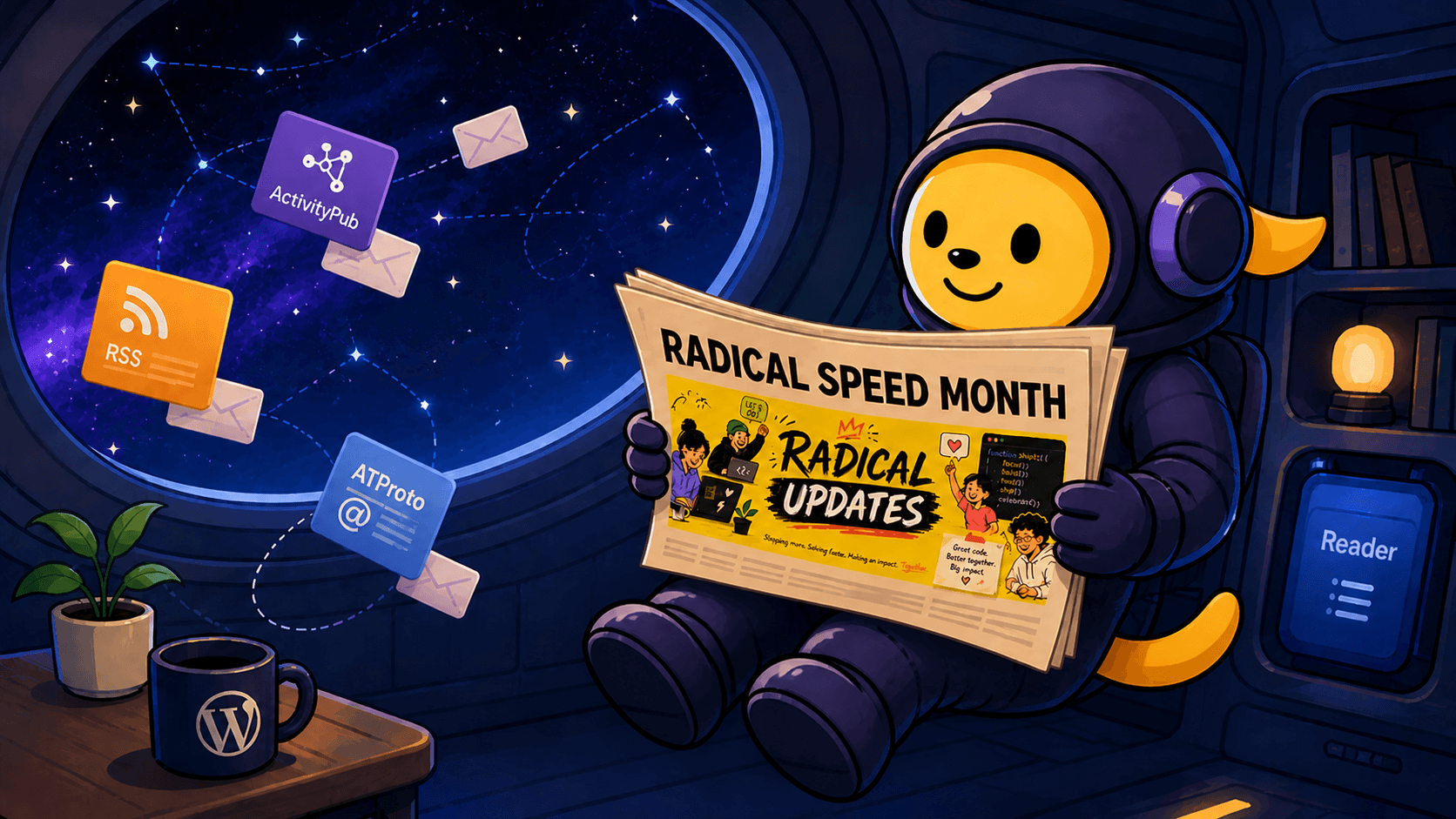
    Wapuu in a space suit floats inside a spaceship, reading a newspaper with a “Radical Speed Month” headline and a yellow update graphic, while message cards for RSS, ActivityPub, and ATProto drift in through a window showing space.

    This post is about work happening on WordPress.com, specifically the Reader, the long-running subscription-and-reading surface that’s been part of WordPress.com since 2008. It’s a sibling effort to the ActivityPub plugin, not a feature of it. We think it matters to plugin readers anyway, because the two pieces are converging, and the converging point is what we’ll be working on next.

    Two weeks ago, Automattic kicked off something internally called Radical Speed Month, a four-week sprint where small teams ship fast on focused projects. We (@jeremy and @pfefferle) took the chance to spend it on something that’s been sitting at the edge of the Fediverse-and-WordPress conversation for a while: making the WordPress.com Reader speak Fediverse.

    Today is roughly the halfway mark, and the picture is clearer than we expected. Here’s what shipped, what’s in flight, and what’s still ahead.

    The thesis

    The Reader on WordPress.com has held a single, useful role for over a decade: it’s where your subscriptions live. Blogs, podcasts, RSS feeds. What it hasn’t done, yet, is read the open social web. Your Mastodon timeline lives in another app. Your Bluesky timeline lives in a third. The Fediverse is out there, and the Reader stays over here.

    The Radical Speed Month bet: ship three protocol adapters in four weeks, and prove the Reader can become a universal aggregator. RSS / Google Reader API (so any reader app can use WordPress.com as a sync backend), ActivityPub (so Mastodon, Pixelfed, and friends show up natively), and ATProto / Bluesky (because that’s where a real chunk of the social-web conversation has gone). One Reader, every protocol you care about.

    If you’ve been following the ActivityPub plugin for a while, you already know one half of this story, your blog speaking out to the Fediverse. The other half is reading in, and that’s where this month’s work concentrates.

    What’s already landed

    Reader as a sync backend

    Any Google Reader-compatible app can now point at WordPress.com and use it as a sync backend. That includes Reeder, NetNewsWire, ReadKit, lire, Unread, Fiery Feeds, Feed Me, and Read You. The auth onboarding is short, and your subscriptions, read state, and stars sync across whichever app you actually like. We’re working on a setup guide that walks through the steps for the most common apps; it should land soon.

    This wasn’t directly Fediverse work, but it’s part of the same idea: the Reader as a backend, not a destination. If your reading habit lives in a different app, that’s fine. Your subscriptions still live on WordPress.com.

    Bluesky timelines, threads, and profiles

    The Bluesky / ATProto adapter has moved further than the original plan suggested.

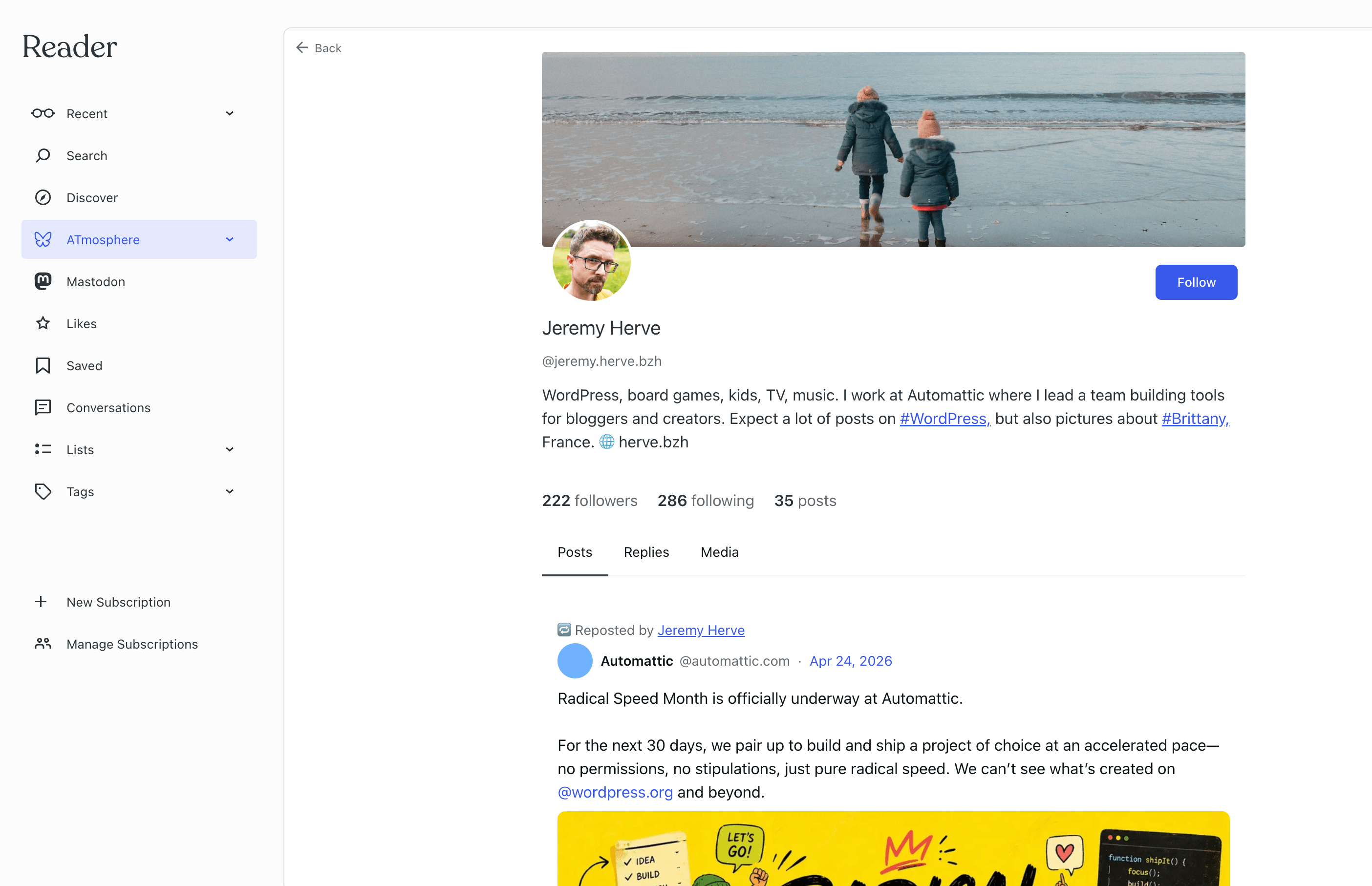
    The image shows Jeremy Herves Bluesky profile in the reader.

    You can:

    • Connect a Bluesky account through the Reader’s connections panel, with a Verify step that confirms the handshake works on both sides.
    • Read your Bluesky home timeline as a tab in the Reader, with native rendering for facets, embeds, and quote posts.
    • Follow links inward, opening a thread in the Reader, viewing an author’s profile, browsing their posts / replies / media filter tabs, following a hashtag.
    • Follow and unfollow Bluesky accounts directly from the profile pages.
    • Like posts, repost posts, and reply to posts. A shared composer for replies is in late review.

    The remaining piece on the Bluesky side is quote-posting and deleting your own posts, which we’re shipping together. After that, Bluesky is a complete first-class tab in the Reader.

    Mastodon, the same shape

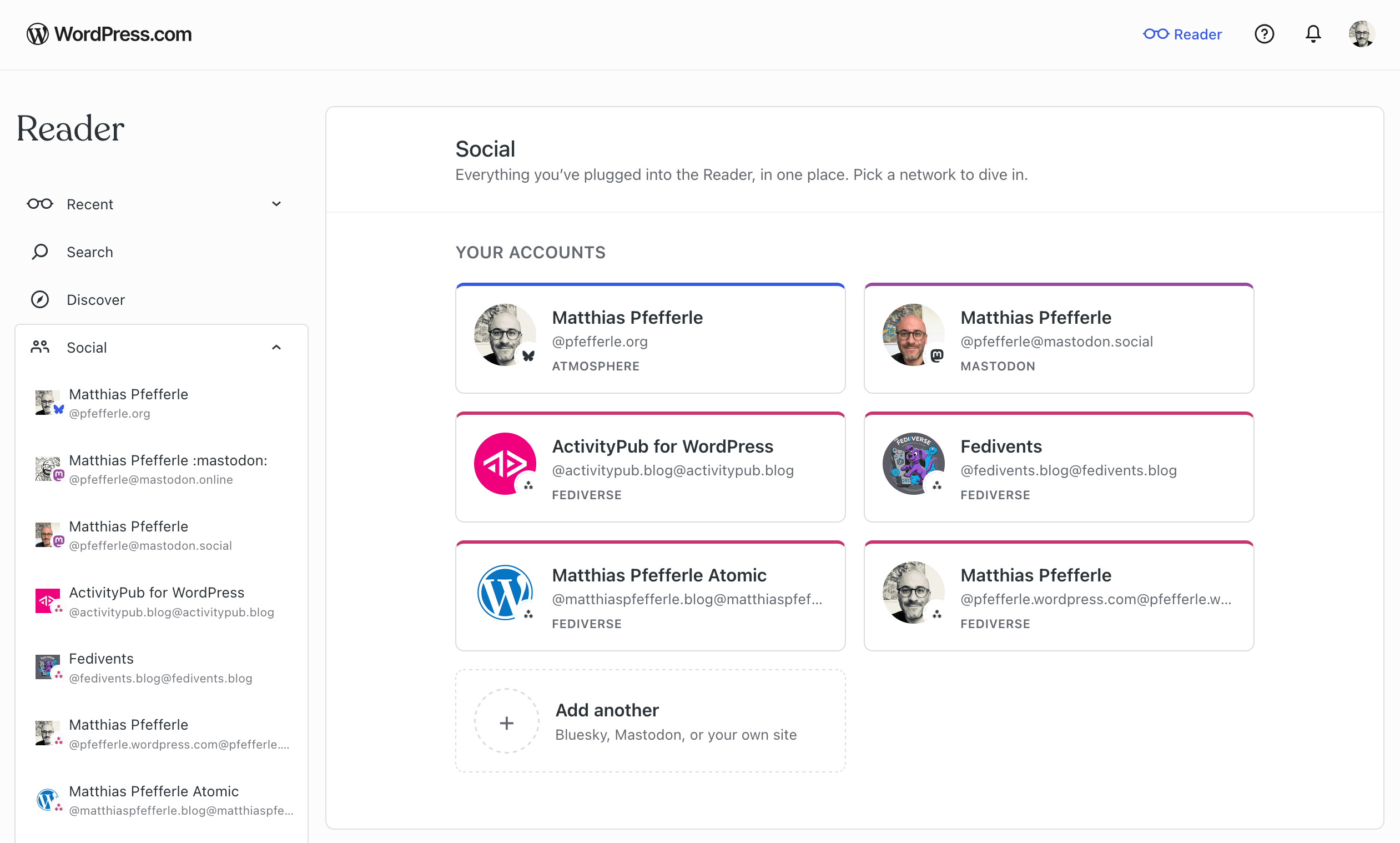
    Mastodon followed the same pattern: connect, verify, then a steady cadence of small additions like timeline, in-app threads, author profile and feed (with Posts / Replies / Media filter tabs), and tag and hashtag feeds. All of those are live for Mastodon today.

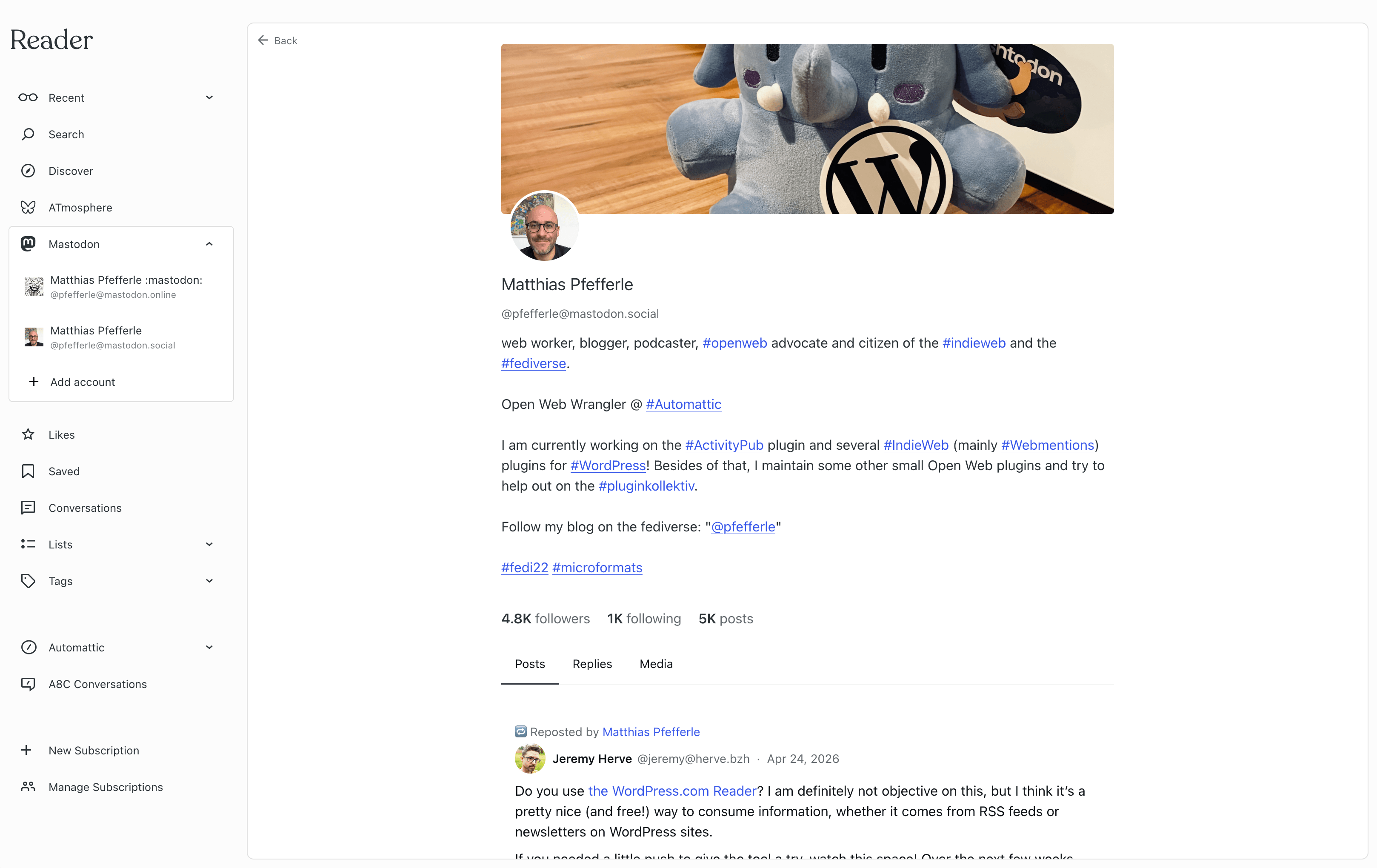
    The image shows Matthias Pfefferles Mastodon profile in the reader.

    What’s still coming on the Mastodon side is the equivalent of the Bluesky interaction work (favourite, boost, reply, quote) built on the same shape that worked for Bluesky. Expect those to land in the second half of this month.

    How this connects to the plugin

    If you read 8.1.0 — By the Numbers, you’ll have noticed a small line in the announcement: the plugin now exposes an ActivityPub API. It’s experimental, behind a feature flag, and lets third-party apps create, edit, and delete posts on your blog the way they would post to a Mastodon account.

    That work isn’t an accident. It’s one half of a bridge, and Radical Speed Month is the other half.

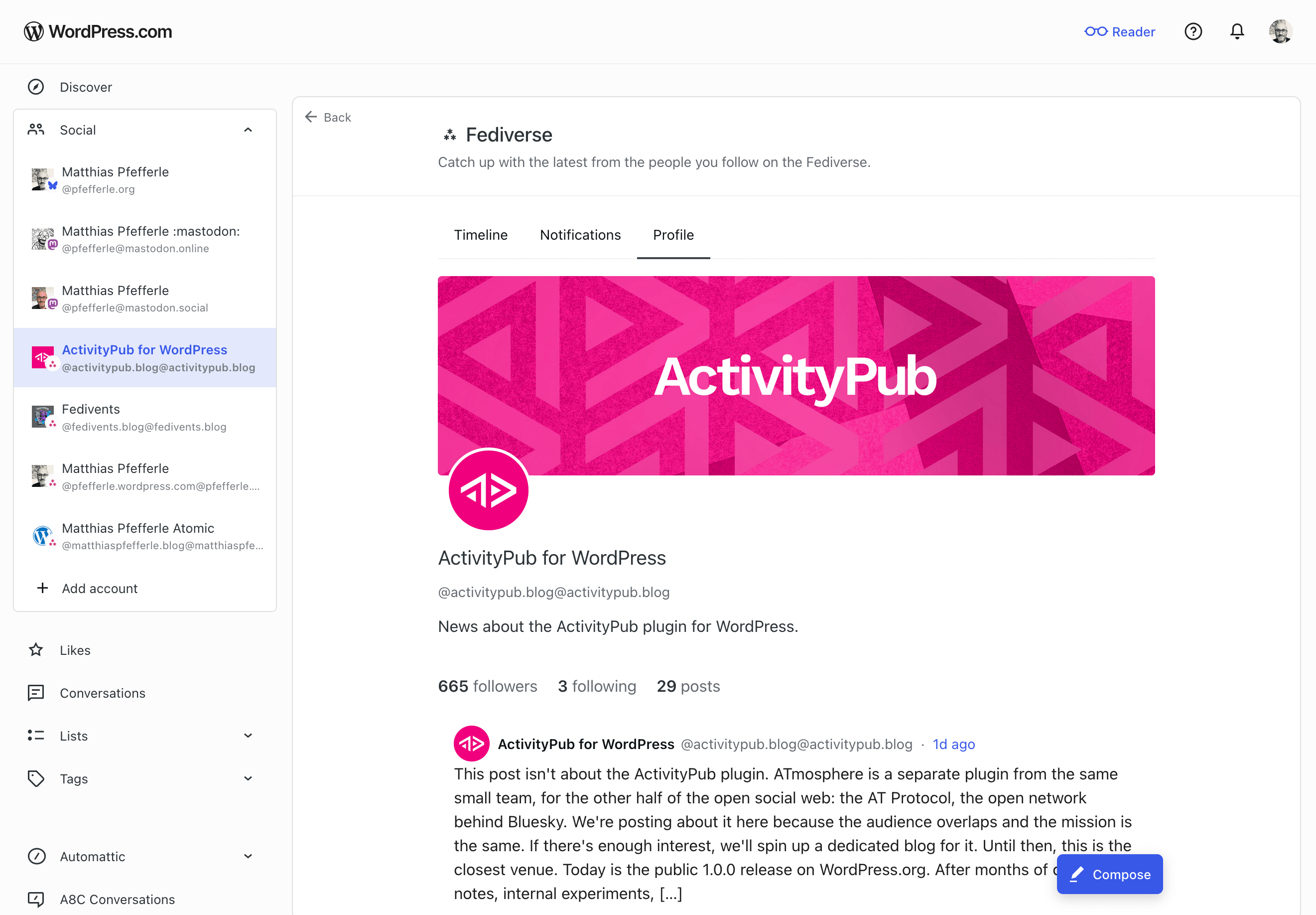
    The Mastodon-in-Reader work that shipped this month is user-level: you connect your Mastodon account once, and the Reader can sync your Mastodon timeline regardless of where your blog lives. That’s a useful starting point, but it’s not the only path forward. The model we’ve been working toward for a year is blog-level: each ActivityPub-enabled WordPress blog as its own social identity inside the Reader, with the plugin providing the actor and the ActivityPub API providing the connection.

    That work is on the schedule for the second half of the month. The radical-speed pace gave us proof first: timelines, threads, profiles, and interactions can all run through one shared pattern, with two networks already validating it. With the pattern in place and the plugin’s ActivityPub API ready to talk to, the blog-level path slots into the same architecture, letting your plugin-enabled blog appear as an ActivityPub identity in the Reader sidebar, with its inbox, its outbox, and its real ActivityPub follow graph. And because the API is part of the ActivityPub standard, the same path works for any Reader or client that speaks it, not just WordPress.com.

    What’s still planned

    A short list of what we’re chasing for the second half of the month and just past it:

    • Quote-posting and delete-your-own-post for both Bluesky and Mastodon, the last pieces of the interaction set.
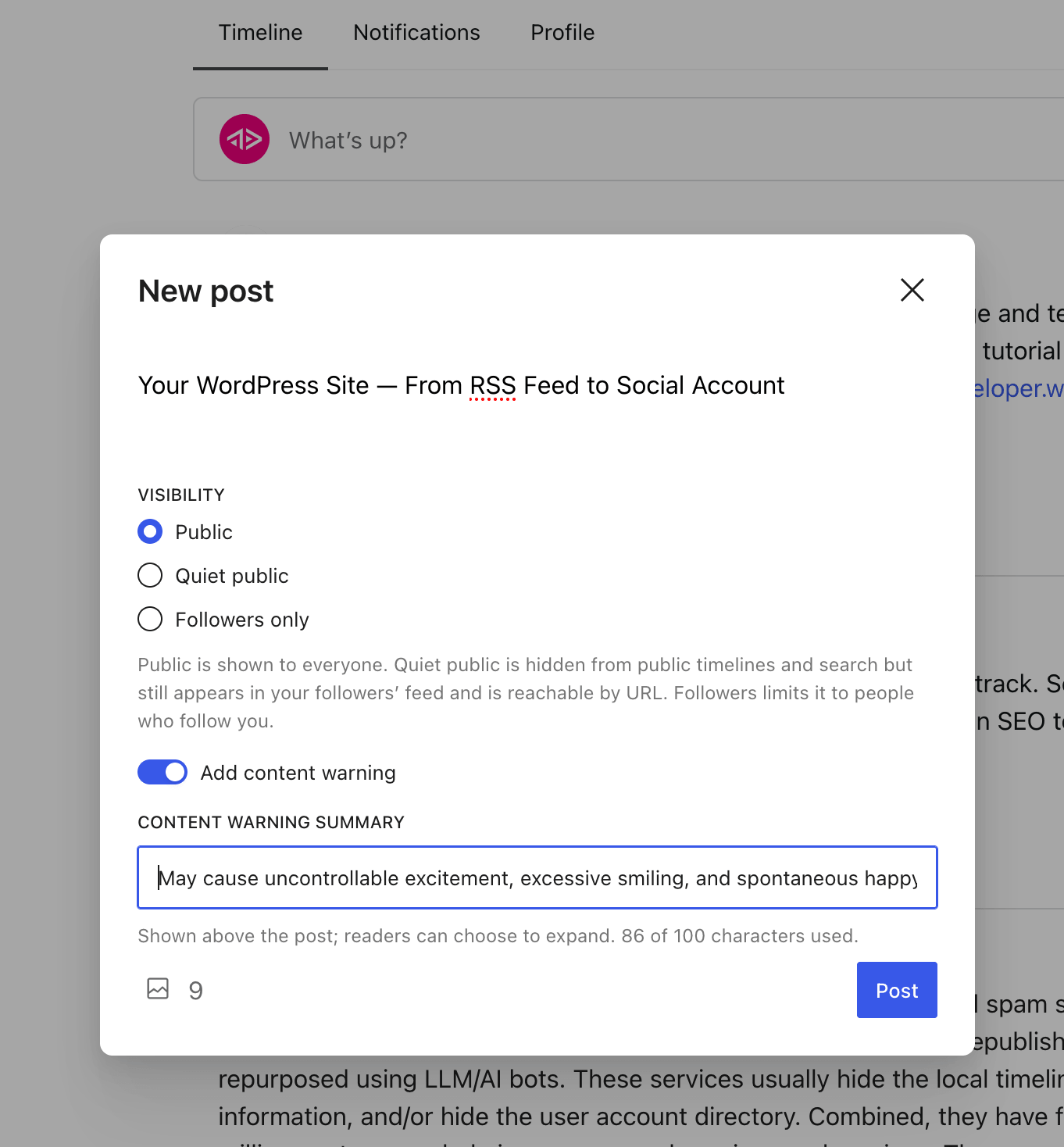
    • A shared composer that handles replies, quote-posts, and standalone posts across networks. Already in progress on the Bluesky side; Mastodon plugs in next.
    • Disconnect, a clean way to remove a Mastodon or Bluesky connection from the Reader.
    • Blog-level ActivityPub, the design pass and first slices for plugin-enabled blogs as first-class Reader identities. The user-level work proved the pattern; this is where the plugin and the Reader actually meet.
    • Tightening the shared pattern so adding the next network (Threads, Pixelfed, whatever comes after) is incremental work.
    • Wrap-up, a metrics snapshot, an honest retrospective, and the heads-up notes our customer-support folks need before the work goes broad.

    A note on speed

    A month feels short to ship three protocols’ worth of reading, profiles, and interactions. It’s worth saying out loud: this didn’t happen because we worked unsustainable hours. It happened because we sat with the design for months, picked a shape that lets each protocol reuse the same plumbing, and broke the work into pieces small enough that any one was reviewable in a day or two. “Radical speed” turned out to mean: a backlog of careful design, drained quickly.

    What this means for you

    If you run an ActivityPub-enabled WordPress blog, whether on WordPress.com or self-hosted, the practical takeaway is small for now and meaningful soon. The plugin’s ActivityPub API in 8.1.0 is the foundation for your blog showing up as a real social identity inside any Reader or app that speaks the same protocol. The WordPress.com Reader is the first concrete target, but the universality matters: any client that implements the standard can talk to your plugin-enabled blog the same way.

    Already, the work this month means there’s now a Reader on WordPress.com that knows how to read the Fediverse alongside RSS and Bluesky. That’s a meaningful thing to have built, and the bridge from your plugin-enabled blog to that Reader is what the second half of the month is about.

    Tell us what you’d like to see

    We’ll keep posting updates as the month closes out. If you have thoughts on what blog-level ActivityPub in the Reader should look like, what protocols you’d want next, or how the plugin’s ActivityPub API should evolve to make this seamless, leave a comment on the plugin’s GitHub repository or reply on the Fediverse. We read every message.

  • Discover more of the Fediverse with tags.pub

    One of the best things about the Fediverse is that conversations happen everywhere, across Mastodon, WordPress, Pixelfed, and dozens of other platforms. One of the trickiest things about the Fediverse is finding those conversations in the first place.

    Wapuu in a space suit floats through a colorful nebula, reaching out to catch glowing hashtag symbols drifting like stars across a wide cosmic background.

    Hashtags have always been the Fediverse’s answer to discovery. But because the network is decentralized, the posts you see for any given hashtag depend on which servers yours already knows about. If nobody on your server follows someone who posted about #WordPressFederation, you’ll never see that post, even though it’s public and out there.

    tags.pub changes that.

    What Is tags.pub?

    tags.pub is a global hashtag server built by the Social Web Foundation, a nonprofit dedicated to growing the open social web, and an organization Automattic is proud to partner with.

    The idea is simple: tags.pub collects publicly posted content from across the Fediverse and redistributes it based on hashtags. When you follow a hashtag account like @photography@tags.pub, you’ll see posts tagged #photography from servers your instance might never have heard of. It fills in the gaps that decentralization naturally creates.

    The project is open source (AGPL-3.0), privacy-conscious, it doesn’t store post content, images, or media, and respects user controls like #NoTagsPub and #NoBots opt-outs.

    How It Works on WordPress.com

    If you’re running a WordPress.com site with the ActivityPub plugin, there’s nothing to configure. tags.pub already works out of the box. Your public posts and their hashtags are discoverable across the Fediverse through tags.pub, and you can follow hashtag accounts from your Following page.

    Connecting a Self-Hosted WordPress Site

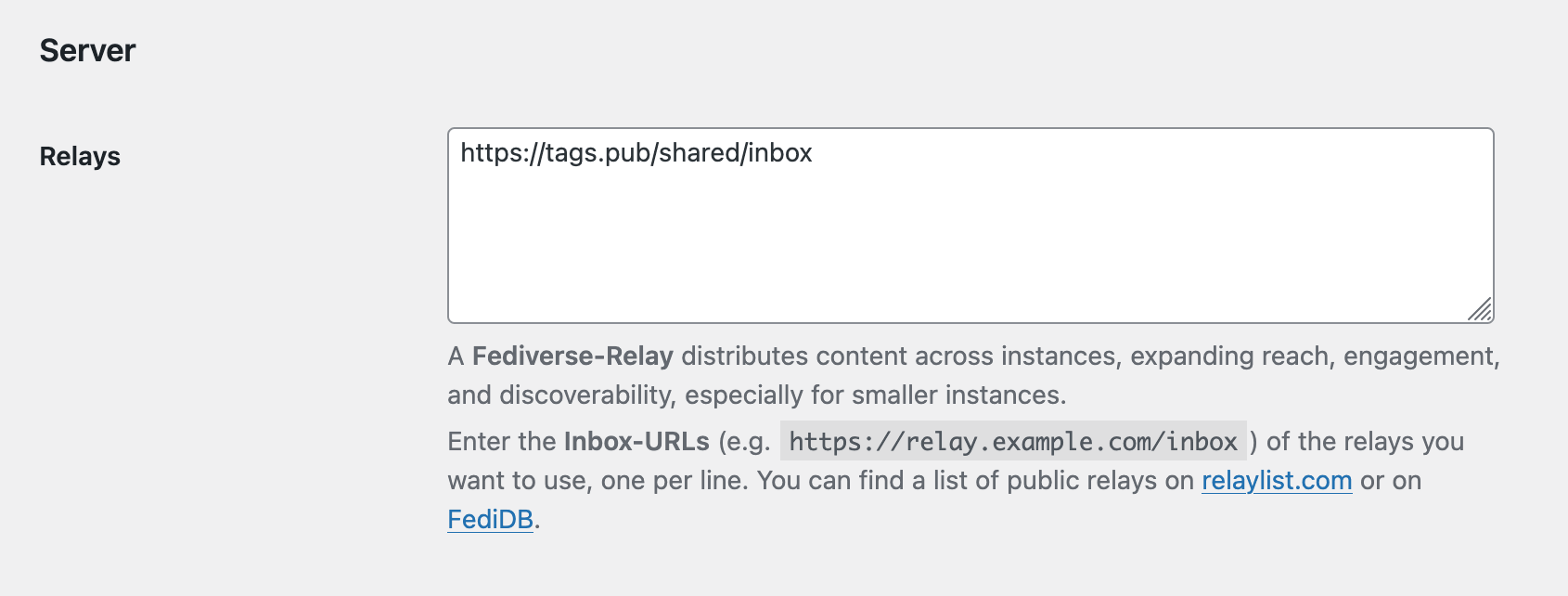
    For self-hosted WordPress sites, head to Settings → ActivityPub → Settings and scroll to the Relay section. Add one of these URLs:

    • Inbox: https://tags.pub/user/_____relay_____/inbox
    • Shared Inbox: https://tags.pub/shared/inbox
    A screenshot of the Relay-Settings of the ActivityPub plugin.

    This creates a one-way connection where your server sends public posts to tags.pub for hashtag distribution, and your posts become part of the global hashtag network.

    Following Hashtags

    Once connected, you can also follow specific hashtags by searching for them as accounts. For example, to follow #WordPress posts from across the entire Fediverse, follow:

    @wordpress@tags.pub

    Any publicly tagged post that reaches tags.pub will be boosted by that account into your timeline. When posts are edited or deleted, tags.pub updates accordingly.

    Privacy and Control

    tags.pub is designed with user agency in mind:

    • Opt out anytime by adding #NoTagsPub or #NoBots to your bio, your posts won’t be boosted.
    • Block the domain entirely if you prefer not to interact with the service at all.
    • No content storage, tags.pub doesn’t archive your posts, images, or media. It only maintains boost records.
    • Respects blocks, if someone blocks tags.pub, their content stays out.

    A Step Toward Better Discovery

    Discoverability is one of the areas we’ve identified on our 2026 roadmap as a key challenge, and services like tags.pub are exactly the kind of infrastructure that helps solve it. By connecting WordPress sites to a global hashtag network, your posts can reach people who care about the same topics, even if they’ve never heard of your blog before.

    If you’re already using ActivityPub for WordPress, connecting to tags.pub takes less than a minute. Give it a try and let us know how it works for you. Have you noticed more engagement from the wider Fediverse? We’d love to hear about your experience.

  • Join Us for Office Hours: Dec 1-5

    We’re excited to announce that the ActivityPub for WordPress team will be hosting open office hours during the first week of December! Whether you’re just getting started with ActivityPub, running into setup issues, or want to chat about where the plugin is heading, we’d love to see you there.

    What Are Office Hours?

    Think of office hours as an open door to hang out with @pfefferle and @obenland. Drop in anytime during the scheduled sessions to get hands-on help with plugin installation and setup, troubleshoot any issues you’re experiencing, or share your ideas for new features and improvements. You can also discuss the roadmap and what’s coming next, ask questions about ActivityPub, the fediverse, or how it all works, and connect with the community to see what others are building.

    No agenda, no registration required—just show up when you can and let’s talk ActivityPub!

    Schedule: December 1-5, 2025

    We’re offering multiple sessions throughout the week to accommodate different time zones. Join whichever works best for you!

    Monday
    Dec 1
    Tuesday
    Dec 2
    Wednesday
    Dec 3
    Thursday
    Dec 4
    Friday
    Dec 5
    10:00 CET🗓️ Add to Calendar🗓️ Add to Calendar🗓️ Add to Calendar
    10 am ET📅 Add to Calendar📅 Add to Calendar📅 Add to Calendar📅 Add to Calendar📅 Add to Calendar

    Time zone note: CET = Central European Time | ET = Eastern Time (US)

    Wapuu, the yellow WordPress mascot, sits at a clean support desk wearing a headset and a blue ActivityPub-themed hoodie. Floating holographic icons hover above the desk, including comments, question marks, and the Fediverse logo, representing community support. A soft, starry space background shines through a large window behind Wapuu.

    How to Join

    Meeting Link: https://meet.google.com/mdb-bkdw-ypz

    Just click the link above at any scheduled time and join us! No need to RSVP—these are open sessions where anyone can drop in.

    New to video calls? No worries! Just click the link, and you’ll be guided through joining. Most platforms work right in your browser.

    Who Should Come?

    Everyone! Seriously, we mean it:

    • WordPress site owners curious about connecting to the fediverse.
    • Developers working with the ActivityPub plugin.
    • Fediverse enthusiasts who want to understand how WordPress fits in.
    • Anyone with questions, bug reports, or ideas.
    • Lurkers welcome too—feel free to just listen and learn!

    Whether you’re running a personal blog, a community site, or just exploring what ActivityPub can do, we’d love to meet you.

    Can’t Make These Times?

    We know December 1-5 won’t work for everyone. If you can’t join us live, you can connect with us on GitHub or join the conversation in our community forum.

    We’re planning to do more office hours in the future based on how this week goes, so let us know what times work better for you!

    See You There! 👋

    We’re really looking forward to connecting with the community, answering your questions, and hearing about how you’re using ActivityPub on WordPress. Mark your calendars, grab a coffee (or tea!), and let’s chat!

    Have questions before office hours? Drop a comment below.

  • Help Shape the Future of Moderation in the Fediverse

    Running a community in the Fediverse means balancing openness with safety. Every year, @iftas takes the pulse of administrators, moderators, and community managers with their Annual Needs Assessment. This survey helps identify what’s working, where support is needed, and which tools can make a difference for those keeping decentralized spaces safe.

    The 2025 survey is now open

    Take part in the IFTAS Needs Assessment (5–10 minutes).

    (If you haven’t seen them before, you can also take a look at last year’s report)

    Last year’s responses represented moderators of over 4.3 million accounts across ActivityPub platforms. With WordPress now the largest group of federating instances, it’s especially important for our community of hosts, site admins, and moderators to be heard.

    Moderation in WordPress: From Site-Wide to Personal Controls

    We recently introduced a major update to the ActivityPub plugin for WordPress: personalized and site-wide moderation tools.

    • Site administrators can now set domain, keyword, and actor-level blocks that protect the entire site.
    • Individual users can fine-tune their own experience with personal blocks, managed directly from their profiles.
    • Content is checked against both global and personal rules—so moderation works at every level.

    These improvements directly address needs raised in previous IFTAS surveys, making moderation more discoverable, flexible, and effective for WordPress communities in the Fediverse.

    Your Input Matters

    IFTAS uses the Needs Assessment to guide tools, policies, and advocacy that reflect the real-world challenges of moderators—especially those in under-resourced communities. The more representative the responses, the stronger the outcomes for everyone.

    If you’re running a federating WordPress site, please consider:

    1. Filling out the survey yourself.
    2. Sharing it with other admins, moderators, and community organizers.
    3. Reminding folks that it’s anonymous, quick, and impactful.

    Together, we can keep building a safer, healthier Fediverse—one that reflects the needs of its communities.