Tag: Following

  • 7.5.0 — Follow the Feed, Quote the Lead

    We’re back with a fresh release, and this one makes following and sharing smoother than ever—plus gives you more control over how your posts can be quoted.

    A New Way to Follow (For Now)

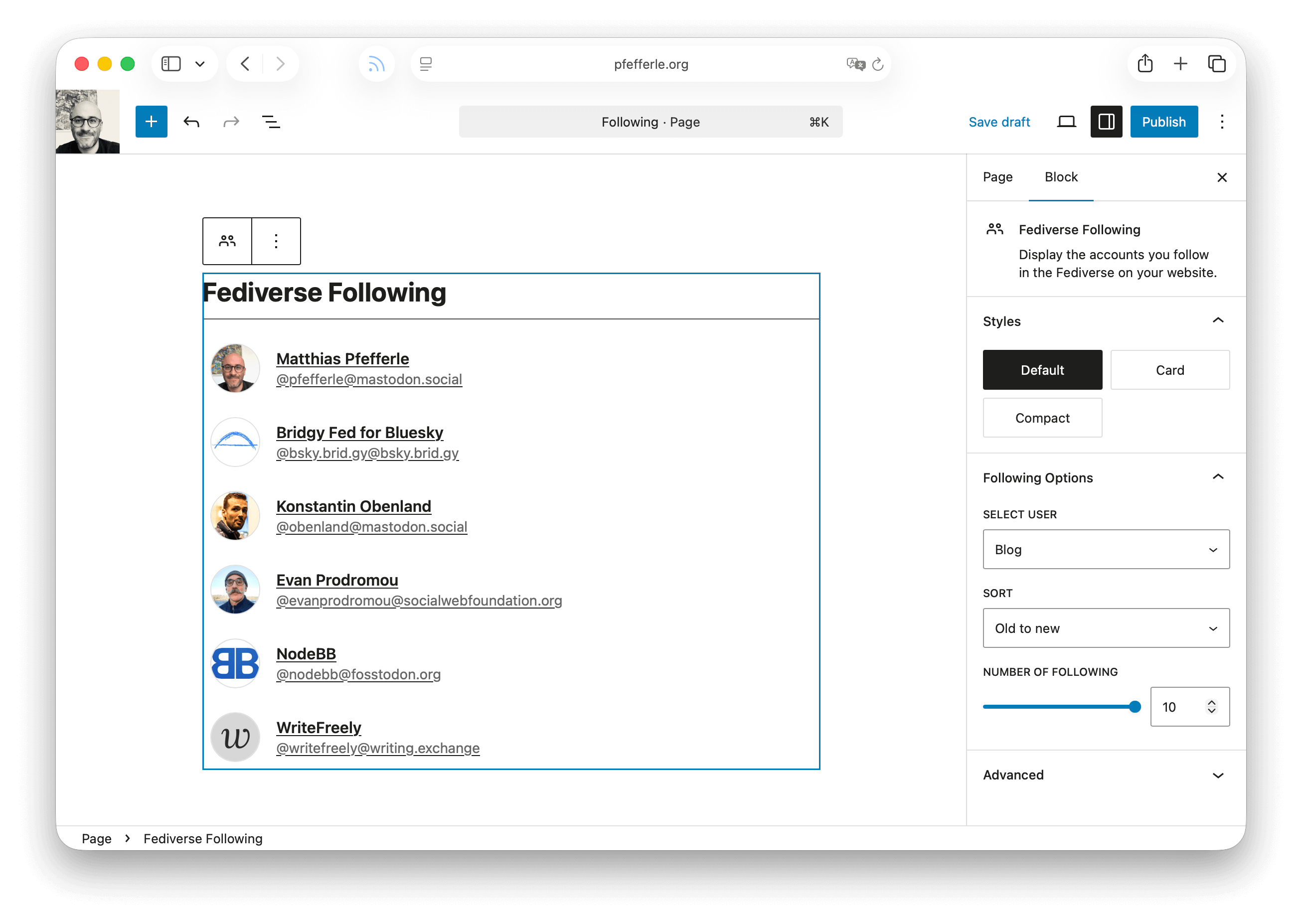
    Starting today, users on WordPress.com sites and self-hosted sites connected through Jetpack can see the posts of accounts they follow directly in their WordPress.com Reader timeline. The Following UI has been around for a little while, yet hidden, and with this release it will be enabled by default for these sites.

    When you follow an account, ActivityPub checks for a discoverable RSS feed. If one exists, it’s automatically added to your Reader timeline so new posts appear alongside everything else you already follow. Unfollowing works the same way—the feed disappears when you remove the account. And if you’d like to view the feed for an account you’ve followed, just hover over it in the list table and click View Feed.

    Think of this as a bridge: a simple way to read the posts of accounts you follow today, while we continue building a full, first-class ActivityPub reading experience for tomorrow.

    There are a couple of details to keep in mind. Removing a subscription directly in the Reader won’t update your site’s Following list, and interactions are limited to what RSS allows, which means sharing and reposting rather than the full range of ActivityPub features.

    Running a self-hosted site without Jetpack? You can still enable the Following UI manually—it just won’t connect with the Reader.

    Quote Post Controls

    We’ve also added support for Mastodon’s quote post feature—and given you an easy way to control how others can quote your content.

    A screenshot of a blog post quoted on Mastodon.

    When writing in the Block Editor, you’ll now see a sidebar setting that lets you decide whether everyone can quote your post, only your followers can, or if quoting is reserved for you alone. Once published, Mastodon and other compatible platforms will honor your choice automatically. No extra setup needed—just write, choose, and publish with confidence.

    Full Changelog

    Added

    • Added a setting to control who can quote your posts.
    • Added support for QuoteRequest activities (FEP-044f), enabling proper handling, validation, and policy-based acceptance or rejection of quote requests.
    • Add upgrade routine to enable ActivityPub feeds in WordPress.com Reader
    • Add Yoast SEO integration for author archives site health check.
    • Improved interaction policies with clearer defaults and better Mastodon compatibility.
    • New site health check warns if active Captcha plugins may block ActivityPub comments.
    • Sync following meta to enable RSS feed subscriptions for ActivityPub actors in WordPress.com Reader
    • You can now follow people and see their updates right in the WordPress.com Reader when using Jetpack or WordPress.com.

    Changed

    • Added support for fetching actors by account identifiers and improved reliability of actor retrieval.
    • Clarify error messages in account modal to specify full profile URL format.
    • Improved checks to better identify public Activities.
    • Improved compatibility by making the ‘implements’ field always use multiple entries.
    • Improved recipient handling for clarity and improved visibility handling of activities.
    • Remote reply blocks now sync account info across all blocks on the same page
    • Standardized notification handling with new hooks for better extensibility and consistency.
    • Updated sync allowlist to add support for Jetpack notifications of likes and reposts.

    Fixed

    • Fixed an issue where post metadata in the block editor was missing or failed to update.
    • Fix Flag activity object list processing to preserve URL arrays
    • Fix PHP warning in bulk edit scenario when post_author is missing from $_REQUEST
    • Posts now only fall back to the blog user when blog mode is enabled and no valid author exists, ensuring content negotiation only runs if an Actor is available.

    Downloads

    Thank you!

    Thanks to everyone who contributed code, tested, offered feedback, or lent support along the way. Update to 7.5.0 today and follow, share, and quote to your heart’s content!

  • 7.4.0 – More Control, Less Waiting

    Fediverse life just got a little easier! This release is all about giving you more confidence in how you manage your users — and making your follower, following, and block lists feel lightning fast. Let’s dive in.

    Wapuu, the yellow WordPress mascot, floats in space wearing a gray astronaut suit. In front of Wapuu is a spaceship control panel with the WordPress logo and the Fediverse logo, each with checkboxes. Below them is a large glowing orange ‘CONFIRM’ button. Wapuu points toward the panel, symbolizing making a choice.

    Clean Breaks, Done Right

    Until now, removing someone’s ActivityPub capability in WordPress only affected their local account. Their presence in the Fediverse lingered on. With this release, you’re in charge of what happens next.

    When you remove ActivityPub capabilities from users on your site, you’ll now see a confirmation step:

    A screenshot of the confirmation step that shows after removing the ActivityPub capability from users.

    With this change, you can decide whether you’re simply adjusting roles inside WordPress, or making a complete exit across the network.

    We’ve also expanded delete handling to cover more scenarios:

    • Comment removal: Permanently deleted federated comments now send a Delete activity across the Fediverse.
    • Virtual deletes & restores: You can now remove objects from the Fediverse without deleting them locally — and bring them back if needed.
    • WP-CLI command for Actors: A new command makes it easier to manage and clean up Actors directly from the command line.

    Together, these tools make sure your Fediverse presence stays consistent with the choices you make in WordPress.

    Lists That Load in a Snap

    Managing your Fediverse connections shouldn’t feel slow — and now it doesn’t. The follower, following, and block lists are noticeably faster and more reliable in this release.

    Behind the scenes, we cleaned up and centralized how account information is resolved. Instead of each list handling things in its own way, they now all share a single, streamlined method with built-in caching. That means less duplication, less waiting, and a smoother experience every time you browse your lists — even on larger sites.

    Full Changelog

    Added

    • Add activitypub_json REST field for ap_actor posts to access raw JSON data.
    • Add Delete activity support for permanently deleted federated comments.
    • Added a new WP-CLI command to manage Actors.
    • Added confirmation step for bulk removal of ActivityPub capability, asking whether to also delete users from the Fediverse.
    • Adds support for virtual deletes and restores, allowing objects to be removed from the fediverse without being deleted locally.
    • Add Yoast SEO integration for media pages site health check.
    • Optimized WebFinger lookups by centralizing and caching account resolution for faster, more consistent handling across lists.

    Changed

    • Clarified the ‘attachment’ post type description to explain it refers to media library uploads and recommend disabling federation in most cases.
    • Hide site-wide checkbox in block confirmations when accessed from ActivityPub settings page.
    • Improved ActivityPub compatibility by aligning with Mastodon’s Application Actor.
    • It’s now possible to reply to multiple posts using multiple reply blocks.
    • Refactored Reply block to use WordPress core embed functionality for better compatibility and performance.
    • Use wp_interactivity_config() for static values instead of wp_interactivity_state() to improve performance and code clarity.

    Deprecated

    • ActivityPub now defaults to automated object type selection, with the old manual option moved to Advanced settings for compatibility.

    Fixed

    • Fix content visibility override issue preventing authors from changing visibility on older posts.
    • Fix PHP warning when saving ActivityPub settings.
    • Fix query args preservation in collection pagination links.
    • Fix release script to catch more ‘unreleased’ deprecation patterns that were previously missed during version updates.
    • Fix reply block rendering inconsistency where blocks were always converted to @-mentions in ActivityPub content. Now only first reply blocks become @-mentions, others remain as regular links.
    • Stop sending follow notifications to the Application user, since system-level accounts cannot be followed.

    Downloads

    Thanks

    High-fives to everyone who helped chart the course, whether you coded, tested, spotted bugs, or just cheered from the sidelines. You keep this ship flying! 🚀

    Version 7.4.0 has just landed—jump in and tell us how it feels out there in the Fediverse.

  • Bridging the gap

    The image shows the fediverse Wapuu is building a bridge from the Bluesky Space Station to the Fediverse Space Station.

    The Fediverse is intended to be an interoperable, decentralized social network where users can connect across platforms and tools. In practice, though, the reality is more fragmented.

    According to Wikipedia:

    The majority of Fediverse platforms are based on free and open-source software, and create connections between servers using the ActivityPub protocol.

    Still, networks like Bluesky, Nostr, and Diaspora take their own technical paths toward the same vision, which means the fediverse isn’t fully connected just yet.

    Bridgy Fed

    To help address this gap, Ryan Barrett (@snarfed.org) began developing Bridgy Fed, a tool designed to connect these otherwise separate networks:

    Bridgy Fed connects web sites, the fediverse, and Bluesky. You can use it to make your profile on one visible in another, follow people, see their posts, and reply and like and repost them. Interactions work in both directions as much as possible.

    With even more networks on the list.

    While it’s not a native solution, it does help connect people today—and I really appreciate the perspective of Anuj Ahooja (@quillmatiq), CEO of A New Social, the organization behind Bridgy Fed:

    The future of the open social web is people connecting with people no matter what technology they happen to choose. And if bridges and duct tape is what’s necessary, then we’ll continue building bridges, because it’s connections and community over everything.

    You can easily connect your blog to Bluesky using Bridgy by following a few simple steps.

    Bridge your Blog

    You can connect your blog to Bluesky using any self-hosted WordPress site or a paid WordPress.com plan.

    First, go to the ActivityPub settings and open the Screen Options at the top right. Enable the Advanced Settings checkbox and click Save.

    This will reveal the Advanced tab in the settings, where you’ll find the Following User Interface option. Enable that as well.

    Once this feature is active, you’ll be able to access the Following subpage.

    To follow the Bluesky account, enter bsky.brid.gy@bsky.brid.gy into the input box on the left and click Follow. The account should appear in your list shortly. After a few minutes, your follow request will be accepted, and the account will follow your blog back.

    You can verify the connection by checking your Followers list. From this point on, all your new blog posts will also be published on Bluesky. You’ll receive reactions to your posts and even follow requests from Bluesky users.

    That’s it! All your upcoming posts will also be published on Bluesky, you will receive all reactions to your posts and even follow requests.

    If you ever want to stop the bridge from publishing, simply unfollow the Bridgy account and remove it from your Followers list.

    Happy cross-posting bridging :)

    Be Aware

    Even though following other accounts is now possible, there is currently no way to view their incoming posts. Aside from the specific use case described above, following others doesn’t offer much benefit at this stage. Please be cautious if you think you need to follow more people, as it may increase traffic to your site without a clear purpose.

    We’ll let you know as soon as the full reader experience is implemented and will enable all necessary (currently hidden) features at that time.

    Follow us!

    As a proof of concept, you can now also follow our updates on Bluesky via @activitypub.blog.activitypub.blog.ap.brid.gy‬

  • 7.2.0 – Follow ups

    A Wapuu in a spacesuit, equipped with a tool, repairing a spaceship engine.

    We’ve rolled out an update that makes sharing content to the fediverse via ActivityPub even better—especially when it comes to images in comments. Now, when you include an HTML <img> tag that points to a file in your WordPress media library, that image is bundled as a proper attachment in the ActivityStreams payload. This means your followers on other platforms will see both your comment and its image, making conversations more vivid and engaging.

    To protect your privacy and security, only images hosted in your own WordPress media library are supported. Images from external sources are intentionally skipped.

    Smoother Following, Better Interactions

    If you’ve turned on the “Following User Interface” feature in the advanced settings, you’ll see a few nice improvements. The followers list now shows whether you’re already following someone—and if not, you can follow them back with just one click.

    Followers list screenshot showing the "Follow Back" button.

    We’ve also made it easier to follow people from other sites. When you click “Follow” on someone else’s blog, you’ll now be taken to your own site to complete it. It keeps things simple and familiar, even when you start following someone from another site.

    Better Support for Multibyte Text

    Finally, we’ve improved how multibyte characters (like those in Greek and other non-Latin scripts) are handled when generating post summaries for the fediverse. We’ve replaced byte-based string functions with multibyte-safe alternatives and reordered text processing steps to avoid errors.

    Full Changelog

    Added

    • Add image attachment support to federated comments – HTML images in comment content now include proper ActivityStreams attachment fields.
    • Link to the following internal dialog for remote interactions, if the feature is enabled.
    • The followers list now shows follow status and allows quick follow-back actions.
    • Trigger Actor updates on (un)setting a post as sticky.
    • You can now use OrderedCollections as starter packs — just drop in the output from a Follower or Following endpoint.

    Changed

    • Ensure that tests run in production-like conditions, avoiding interference from local development tools.
    • Moved HTTP request signing to a filter instead of calling it directly.

    Fixed

    • Allow non-administrator users to use Follow Me and Followers blocks.
    • Correct linking from followers to the following list.
    • Fix avatar rendering for followers with missing icon property.
    • Fix multibyte character corruption in post summaries, preventing Greek and other non-ASCII text from being garbled during text processing.
    • Informational Fediverse blocks are no longer rendered when posts get added to the Outbox.

    Downloads

    Thank you!

    Huge thanks to everyone who shared code, gave feedback, tested, or simply cheered us on! Together, we’re building a more connected fediverse, one release at a time. ❤️

    We’ve just released version 7.2.0, give it a spin and let us know what you think!

  • 7.1.0 — Polishing Tables

    This release is mostly made up of behind-the-scenes improvements, but one update you’ll notice right away is the refreshed Followers table. It now looks and feels much more like the standard WordPress admin tables: you can customize it with screen options to hide columns or change how many followers are shown per page, and you can now delete individual followers using inline action links. We also polished the layout by increasing information density and improving the readability of date columns.

    We’ve made migrations easier to kick off by automatically resolving account aliases and saving their ID form. That means you can now paste in WebFinger IDs, profile URLs, etc. and the plugin handles the rest, as long as it resolves to an ActivityPub profile.

    This release also fixes a long-time annoyance: unfederated posts (like those published before the plugin was activated or imported later) will no longer be sent out to followers just because they were updated. For now, we use a simple cutoff for posts older than a month, which should cover the majority of those cases.

    Coming Soon: Following Others!

    Most of the work that went into this release is still invisible, hiding behind a feature flag in Advanced Settings (you can find it by opening Screen Options in the ActivityPub settings screen).

    There’s really no functionality around it yet, beyond following accounts from other instances, as we have yet to start processing incoming posts and adding the ability to interact with them. But if you just can’t wait to show your appreciation for other accounts by following them, go wild!

    Behind the same feature flag, we’ve also added initial beta support for Fediverse Starter Kits. This lets new users follow a set of recommended accounts from a predefined list, following the format proposed by @dansup for Pixelfed. For now, only Actor objects are supporteded, but we’re hoping to expand that over time.

    Full Changelog

    Added

    • Added a first version of the Follow form, allowing users to follow other Actors by username or profile link.
    • Added initial support for Fediverse Starter Kits, allowing users to follow recommended accounts from a predefined list.
    • Ensure that all schedulers are registered during every plugin update.
    • Followers and Following list tables now support Columns and Pagination screen options.
    • The featured tags endpoint is now available again for all profiles, showing the most frequently used tags by each user.
    • The following endpoint now returns the actual list of users being followed.

    Changed

    • Follower tables now look closer to what other tables in WordPress look like.
    • Improved Account-Aliases handling by internally normalizing input formats.
    • Minor performance improvement when querying posts of various types, by avoiding double queries.
    • Set older unfederated posts to local visibility by default.
    • Step counts for the Welcome checklist now only take into account steps that are added in the Welcome class.
    • Table actions are now faster by using the Custom Post Type ID instead of the remote user URI, thanks to the unified Actor Model.
    • The following tables now more closely match the appearance of other WordPress tables and can be filtered by status.

    Fixed

    • Ensure correct visibility handling for Undo and Follow requests
    • Ensure that the Actor-ID is always a URL.
    • Fixed a bug in how follow requests were accepted to ensure they work correctly.
    • Fixed an issue where the number of followers shown didn’t always match the actual follower list.
    • Fixed a PHP error that prevented the Follower overview from loading.
    • Fixed missing avatar class so that CSS styles are correctly applied to ActivityPub avatars on the Dashboard.
    • Fixed potential errors when unrelated requests get caught in double-knocking callback.
    • Improved WebFinger fallback to better guess usernames from profile links.
    • Prevent WordPress from loading all admin notices twice on ActivityPub settings pages.
    • Removed follower dates to avoid confusion, as they may not have accurately reflected the actual follow time.
    • Stop purging Follow activities from the Outbox to allow proper Unfollow (Undo) handling.

    Downloads

    Thank you!

    Big thanks to everyone who contributed code, feedback, testing, or encouragement—this community helps make the fediverse more connected with every release. ❤️

    Update to 7.1.0, try it out, and tell us what you think!

  • 7.0.0 – I will follow you!

    Just when you thought things were settling down… boom 💥 — the ActivityPub plugin gets another big upgrade. Say hello to version 7.0.0, a release packed with new features, polish, and under-the-hood improvements to help your WordPress site federate smoother, smarter, and more securely than ever.

    Let’s dive into what’s new.

    Following the Fediverse

    We’ve added the initial building blocks for Following support — both sending and managing follow requests for remote actors. It’s not in the UI just yet (we’re rolling it out carefully), but that’s not far away. A big step toward richer, two-way federation.

    Wapuu that "follows" a Mastodon, Pixelfed and Ghost mascot.

    We’ll work with developers of third-party plugins — including those behind Friends and Event Bridge — to migrate their custom follow implementations to this new core feature. This collaboration helps ensure a consistent, reliable follow experience across the ecosystem.

    This foundational support for following is also the first step toward a full-featured reader experience right inside WordPress — something we’re excited to keep building toward.

    Refined Signature

    This release brings support for RFC-9421-style HTTP signatures, both incoming and (optionally) outgoing. That’s a mouthful, but it basically means supporting the latest standard in how we verify and send activities — including a fallback to good old Draft Cavage when needed.

    Check out the blog post to learn more: HTTP Signature Upgrades Coming Soon

    Full Changelog

    Added

    • Added basic support for handling remote rejections of follow requests.
    • Added basic support for RFC-9421 style signatures for incoming activities.
    • Added initial Following support for Actors, hidden for now until plugins add support.
    • Added missing “Advanced Settings” details to Site Health debug information.
    • Added option to auto-approve reactions like likes and reposts.
    • Added support for namespaced attributes and the dcterms:subject field (FEP-b2b8), as a first step toward phasing out summary-based content warnings.
    • Added support for the WP Rest Cache plugin to help with caching REST API responses.
    • Documented support for FEP-844e.
    • Optional support for RFC-9421 style signatures for outgoing activities, including retry with Draft-Cavage-style signature.
    • Reactions block now supports customizing colors, borders, box-shadows, and typography.
    • Support for sending follow requests to remote actors is now in place, including outbox delivery and status updates—UI integration will follow later.

    Changed

    • Comment feeds now show only comments by default, with a new type filter (e.g., like, all) to customize which reactions appear.
    • Consistent naming of Blog user in Block settings.
    • hs2019 signatures for incoming REST API requests now have their algorithm determined based on their public key.
    • Likes, comments, and reposts from the Fediverse now require either a name or preferredUsername to be set when the Discussion option require_name_email is set to true. It falls back to “Anonymous”, if not.
    • Management of public/private keys for Actors now lives in the Actors collection, in preparation for Signature improvements down the line.
    • Notification emails for new reactions received from the Fediverse now link to the moderation page instead of the edit page, preventing errors and making comment management smoother.
    • Plugins now have full control over which Settings tabs are shown in Settings > Activitypub.
    • Reworked follower structure to simplify handling and enable reuse for following mechanism.
    • Screen options in the Activitypub settings page are now filterable.
    • Setting the blog identifier to empty will no longer trigger an error message about it being the same as an existing user name.
    • Step completion tracking in the Welcome tab now even works when the number of steps gets reduced.
    • The image attachment setting is no longer saved to the database if it matches the default value.
    • The welcome page now links to the correct profile when Blog Only mode was selected in the profile mode step.
    • Unified retrieval of comment avatars and re-used core filters to give access to third-part plugins.

    Fixed

    • Allow interaction redirect URLs that contain an ampersand.
    • Comments received from the Fediverse no longer show an Edit link in the comment list, despite not being editable.
    • Fixed an issue where links to remote likes and boosts could open raw JSON instead of a proper page.
    • Fixed a potential error when getting an Activitypub ID based on a user ID.
    • HTTP signatures using the hs2019 algorithm now get accepted without error.
    • Improved compatibility with older follower data.
    • Inbox requests that are missing an algorithm parameter in their signature no longer create a PHP warning.
    • Interaction attempts that pass a webfinger ID instead of a URL will work again.
    • Names containing HTML entities now get displayed correctly in the Reactions block’s list of users.
    • Prevent storage of empty or default post meta values.
    • The amount of avatars shown in the Reactions block no longer depends on the amount of likes, but is comment type agnostic.
    • The command-line interface extension, accidentally removed in a recent cleanup, has been restored.
    • The image attachment setting now correctly respects a value of 0, instead of falling back to the default.
    • The Welcome screen now loads with proper styling when shown as a fallback.
    • Using categories as hashtags has been removed to prevent conflicts with tags of the same name.
    • When verifying signatures on incoming requests, the digest header now gets checked as expected.

    Downloads

    Thank you!

    Huge thanks to everyone who contributed code, feedback, tests, or moral support. This community makes the fediverse feel a little more federated with every release. ❤️

    Update now, test things out, and let us know how 7.0.0 works for you!


  • Our 2025 Roadmap: Building the Future of WordPress Federation

    A Wapuu in a spacesuit flying through the space holding a ball with the fediverse logo.

    We’re excited to share this roadmap — there’s a lot happening with the ActivityPub plugin, and we can’t wait to show you what’s coming next.

    We often refer to this roadmap in GitHub issues and discussions, but until now, we haven’t published a full roadmap post — nor a formal changelog. This post is a first step toward keeping the community more informed about what’s planned and what’s coming up next.

    Our goal for this year is to finalize the full ActivityPub experience — so that WordPress can be used as a first-class citizen of the Fediverse. This means enabling not only publishing to the network, but also following, reading, interacting, and moderating — all in a seamless way that feels natural for WordPress users.

    This roadmap is not set in stone — priorities may shift based on community feedback, WordPress updates, or changes in the wider Fediverse. But it should give you a good sense of where we’re going.

    Followers/Following

    This is what we’re currently working on. You can follow the progress on GitHub.

    Right now, the plugin supports only Followers. It doesn’t yet offer a way for your site to follow others in the Fediverse. But with new initiatives like the “Reader Experience,” this will need to change.

    To support true two-way relationships — both Followers and Following — we need a database model that can clearly represent both types of connections. The current system, which relies on GUIDs to track remote actors, wasn’t designed for this. At the moment, it can store a remote actor as a follower of your site, but it doesn’t easily support the ability for your site to follow them back.

    Implementing Following cleanly will require rethinking how this data is stored and connected.

    Actors

    This ties into a broader challenge with how the plugin currently models actors — both local users on your site and remote users from other Fediverse servers.

    Today, the plugin uses virtual users to represent these actors. This was a practical choice early on to get federation working without rewriting how WordPress manages users.

    But as the plugin grows — especially with features like Following and the Reader Experience — this approach is creating friction. Virtual users don’t behave exactly like regular WordPress users, so each time we add new features, we end up writing special workarounds.

    Over time, this adds complexity and makes the system harder to maintain. Moving toward a more unified model for actors — one that integrates more naturally with WordPress’s existing structures — will keep the plugin flexible and reliable.

    Moderation

    Currently, the plugin relies on WordPress’s built-in “Disallowed Comment Keys” system to filter unwanted content at the inbox endpoint — before any ActivityPub request is processed. This mechanism allows you to block activities based on keywords or domains, using the same rules you’d apply to comments.

    However, this approach is fairly blunt: it’s a simple keyword filter, not a nuanced moderation tool. This limitation will become more important as the plugin expands — for example, when adding support for image-based comments or richer media interactions.

    Building a dedicated filtering mechanism is an important step toward giving site owners fine-grained moderation tools that are tailored to the unique challenges of federated content.

    More details:

    👉 GitHub — Question: How does this plugin interact with moderation and trust & safety on the fediverse?

    Reader

    A full Reader experience is one of our long-term goals — it’s the final big feature needed to give WordPress sites a complete ActivityPub/Fediverse experience.

    Today, the plugin lets others follow your site, but there’s no built-in way for you to subscribe to and read content from others — in other words, there’s no “timeline” yet inside WordPress.

    We plan to start with a simple, flexible approach: focusing first on storing remote posts in a way that’s compatible with tools like the WordPress.com Reader or third-party plugins like Friends or the Event Bridge for ActivityPub.

    Once this foundation is in place, we’ll iterate on direct support — making it possible for site owners and users to follow and read Fediverse posts right inside WordPress.

    Direct Messages

    As part of this evolution toward a full Reader experience, we’re also exploring support for Direct Messages.

    This is a frequently requested feature and an important part of richer Fediverse interactions. We plan to start with an initial implementation that enables private messaging — and then build on it as we learn from real-world use.

    Fully delete profiles

    One key principle of the GDPR is the “right to be forgotten.”

    Currently, the plugin supports remote deletions, but does not trigger Delete Activities for local user actions.

    The challenge is that WordPress operates differently from most federated social networks. Users might expect Delete Activities for certain actions that could have major consequences — for example, deactivating the plugin.

    But deactivating a plugin is also a common troubleshooting step in WordPress.

    To address this, we first need to define different use cases and guide users on how to trigger Delete Activities appropriately.

    More details:

    👉 GitHub — User Delete Milestone

    Client-to-Server API (exploration)

    In addition to the way servers communicate with each other across the Fediverse, ActivityPub also defines a “Client-to-Server” API.

    This API is mainly designed to allow apps and clients (such as mobile apps) to publish content to a Fediverse server.

    In the future, this could open up interesting possibilities for WordPress — for example, allowing WordPress to act as a bridge or proxy, making it easier to bring in and federate content from other tools or platforms.

    At this stage, we’re exploring and evaluating this based on community interest and potential use cases.

    Staying Informed

    We’ll continue to keep you informed about the progress of this roadmap.

    For each new release, we’ll publish posts highlighting the latest features and improvements. For larger projects — like the Reader experience or expanded moderation tools — we’ll also share regular updates so you can follow along as the work evolves.

    As always, we welcome your feedback and ideas — they help shape the future of the ActivityPub plugin and the growing WordPress Fediverse community! 🚀